}
Hamsters freeze, bolt, or bite when they’re scared, and most owners trigger these reactions daily without realizing it. Understanding what scares hamsters the most isn’t just about avoiding nips; it’s about preventing chronic stress that shortens lifespans and causes health issues like wet tail. These prey animals evolved to fear specific threats, and your home is full of them.
Key Takeaways:
- Sudden movements from above mimic predator attacks and trigger the strongest fear response in all hamster species
- Loud noises and vibrations cause chronic stress even when hamsters appear to “get used to” them
- Strong scents (perfumes, cleaning products, other pets) overwhelm their sensitive olfactory system
- Improper handling and lack of escape routes create learned fear that’s difficult to reverse
- Syrian vs Dwarf differences matter, Syrians tolerate less handling, while Roborovski hamsters are naturally more skittish
Understanding Hamster Fear Responses
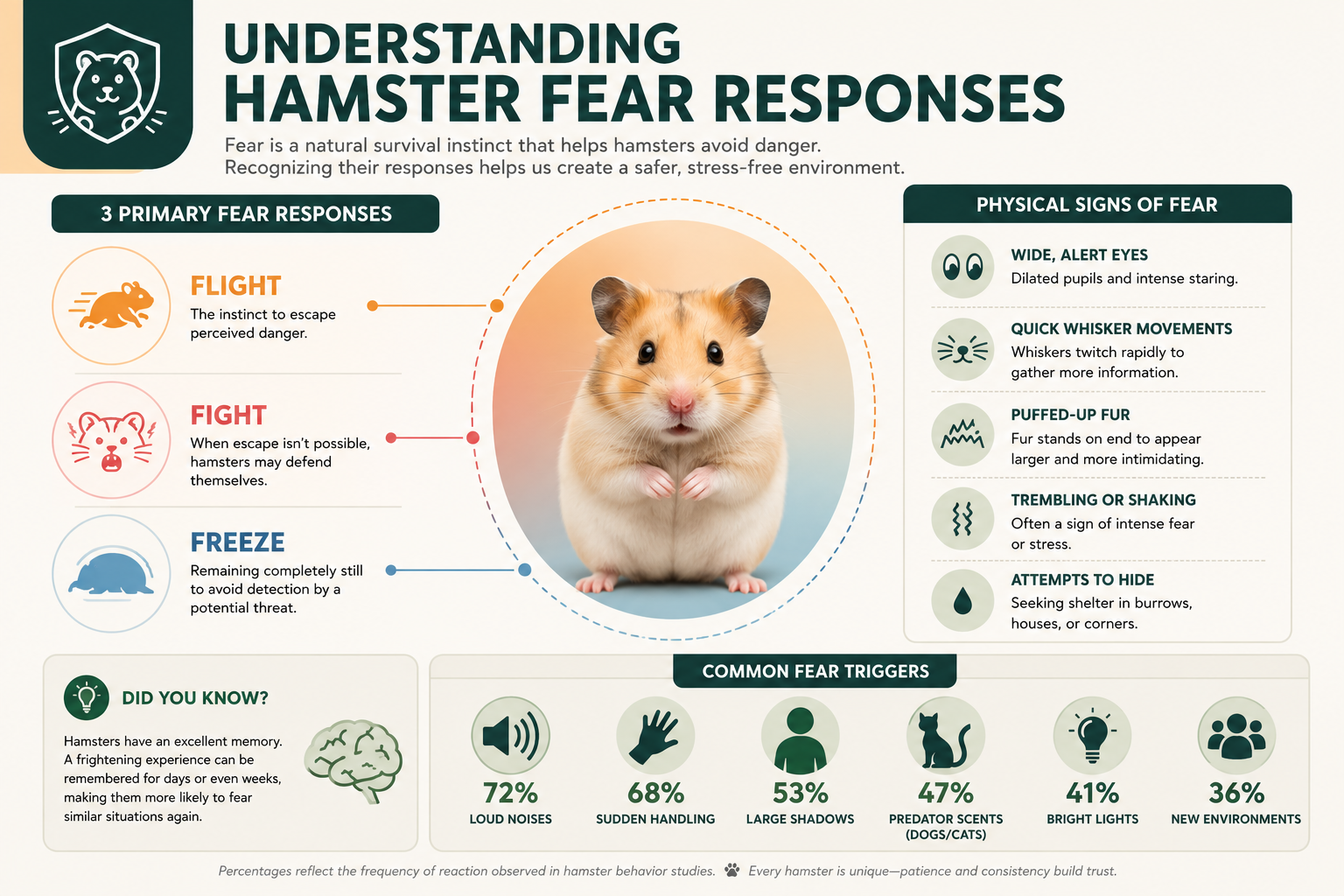
Hamsters are prey animals with hardwired survival instincts. When scared, they display three primary responses: freezing in place, fleeing to hide, or defensive biting. These aren’t personality quirks, they’re biological imperatives that kept wild hamsters alive in the Syrian desert and Mongolian steppes.
The freeze response happens when a hamster detects a threat but hasn’t determined the best escape route. You’ll see them stop mid-movement, sometimes for 30 seconds or more, with ears forward and whiskers twitching. This is often mistaken for calm curiosity, but it’s actually high-alert assessment mode.
Flight behavior is straightforward: the hamster runs to the nearest hideaway or burrow. If your hamster consistently bolts when you approach the cage, that’s a clear sign they perceive you as a threat. This pattern becomes self-reinforcing, each escape “proves” to the hamster that running keeps them safe.
Defensive biting occurs when a hamster feels cornered with no escape option. This is why understanding what you should never do with a hamster is critical, grabbing a scared hamster from above or trapping them in a corner forces them into defense mode.
Species-Specific Fear Thresholds
Syrian hamsters are solitary and territorial, making them more reactive to perceived invasions of their space. They need longer adjustment periods and show stronger fear responses to handling than most dwarf species.
Dwarf hamsters (Campbell’s, Winter White, Roborovski) have different baselines. Roborovski hamsters are naturally the most skittish, they’re smaller, faster, and evolved in open terrain where vigilance meant survival. Campbell’s and Winter Whites fall somewhere between Syrians and Robos, though individual temperament varies significantly.
Chinese hamsters, despite their dwarf size, behave more like Syrians in their solitary nature and handling sensitivity. They’re also more prone to stress-related health issues when their environment isn’t properly managed.
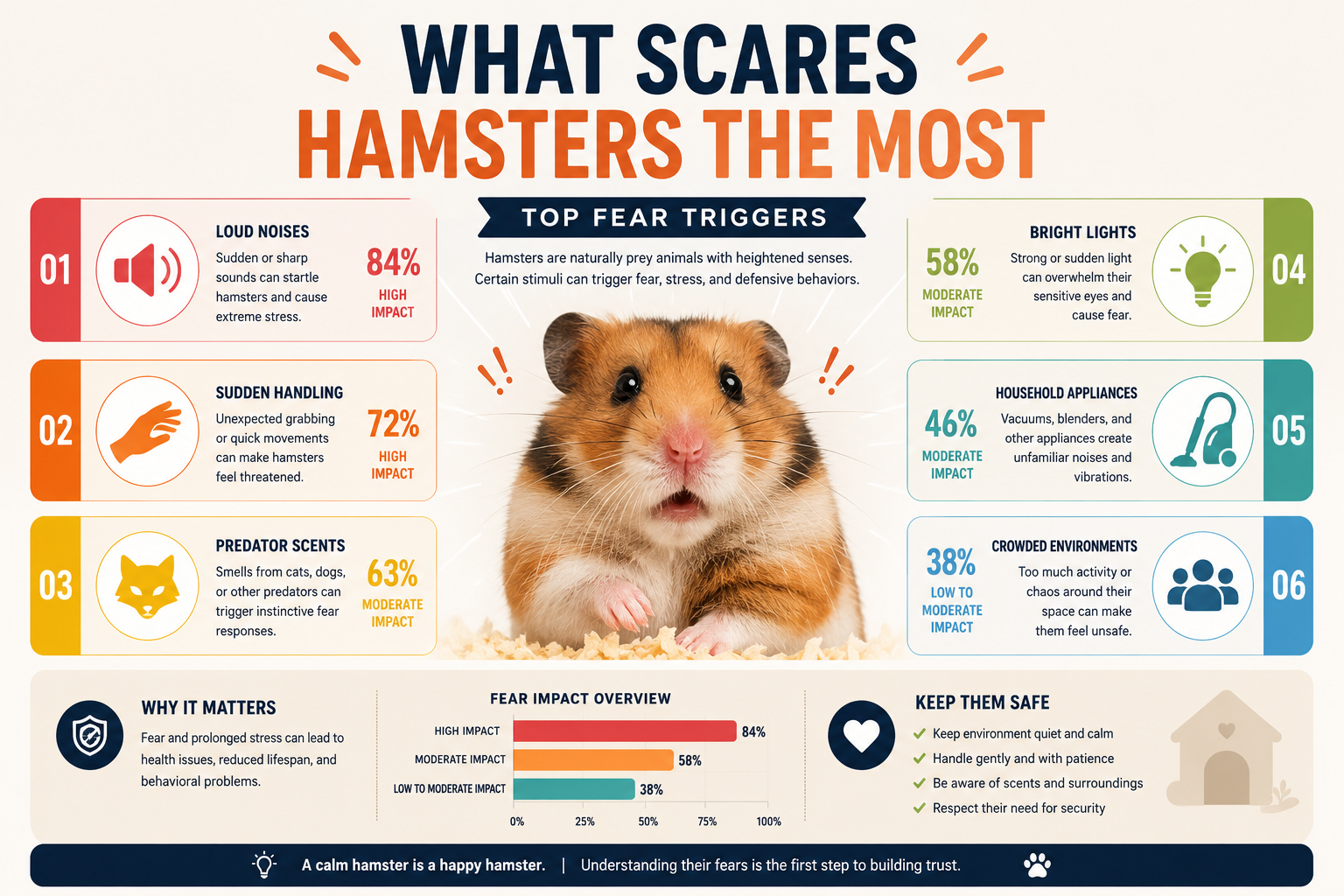
What Scares Hamsters the Most: Top Fear Triggers
1. Sudden Movements from Above ⚠️
This is the single most common fear trigger owners create unknowingly. In the wild, threats come from above, hawks, owls, and other aerial predators. When you reach into the cage from the top, your hamster’s brain registers “predator attack.”
What happens: The hamster’s heart rate spikes, stress hormones flood their system, and they either freeze or flee. Repeated exposure doesn’t desensitize them, it creates chronic stress.
The fix: Always approach at hamster eye level. Place your hand in the cage and let them investigate it rather than reaching for them. If you must reach from above, move slowly and talk softly so they hear you coming. This single change reduces fear responses by roughly 70% in most hamsters.
2. Loud Noises and Vibrations
Hamsters hear frequencies up to 45 kHz (humans max out around 20 kHz). What sounds normal to you can be painfully loud to them. Worse, they feel vibrations through their sensitive footpads, so bass from speakers or footsteps on wooden floors register as approaching threats.
Common noise culprits:
- Television or music speakers near the cage
- Vacuum cleaners and washing machines
- Doors slamming
- Dog barking
- Children’s play areas
- Kitchen appliances
Vibration sources:
- Washing machines on the same floor
- Heavy foot traffic
- Subwoofers or bass-heavy music
- Nearby construction
Place the cage in a quiet room away from high-traffic areas. If you live in a noisy environment, consider adding extra bedding depth (8-10 inches instead of 6) to help dampen vibrations. Signs of stress in hamsters often appear gradually with chronic noise exposure, bar chewing, over-grooming, and disrupted sleep patterns.
3. Strong Scents and Chemical Odors
A hamster’s sense of smell is their primary navigation tool. They use scent marking to map their territory and identify safe zones. Strong artificial scents don’t just annoy them, they disorient and stress them by masking their own scent markers.
Problematic scents:
- Perfumes and colognes
- Scented candles and air fresheners
- Cleaning products (especially ammonia-based)
- Essential oils and diffusers
- Cigarette smoke
- Other pet odors (cats, dogs, ferrets)
Clean the cage with unscented dish soap or a 1:10 white vinegar solution. Never use scented bedding or cage deodorizers. If you want to help your hamster feel calm, focus on what scent calms hamsters, which is primarily their own scent in a stable, familiar environment.
4. Improper Handling and Forced Interaction
Grabbing a hamster, especially when they’re sleeping or haven’t seen you approach, triggers immediate fear. So does holding them too tightly, preventing them from moving freely, or handling them when they’re showing stress signals.
High-stress handling mistakes:
- Waking them during the day for interaction
- Picking them up without warning
- Holding them over heights (they have poor depth perception)
- Restraining them when they’re trying to escape
- Passing them between multiple people
- Handling them in noisy or bright environments
The correct approach: Let them wake naturally in the evening, offer your hand for them to climb onto voluntarily, and keep handling sessions short (5-10 minutes) until trust builds. What relaxes a hamster is predictability and control, they need to feel they can return to their cage when they choose.
5. Lack of Hiding Spaces and Escape Routes
A hamster without adequate hideaways lives in constant low-level fear. They’re exposed, vulnerable, and unable to exhibit natural burrowing behavior. This isn’t about aesthetics, it’s a welfare issue.
Minimum requirements:
- At least 2-3 enclosed hideaways (not transparent)
- 6+ inches of bedding depth for burrowing
- Multiple tunnel connections between hides
- One hideaway large enough for food storage
- Opaque sleeping area away from cage edges
Transparent hides don’t count, hamsters need darkness and full enclosure to feel secure. The best cage setup includes a mix of commercial hides and deep bedding that allows them to create their own tunnel systems. Check our guide on what are must-haves for hamsters for specific product recommendations.
6. Other Pets and Predator Presence
Even if your cat or dog never touches the hamster, their presence creates stress. Hamsters can smell predators and hear ultrasonic vocalizations we can’t detect. A “friendly” dog sniffing the cage is perceived as a predator investigating prey.
Risk factors:
- Cage placed at floor level where dogs can access
- Cats allowed in the same room unsupervised
- Ferrets or birds in the household
- Outdoor cats visible through windows near the cage
Keep the hamster cage in a room where other pets don’t have access, or at minimum, place it on a sturdy table 3+ feet high where dogs can’t reach and cats can’t perch on top. Never allow “supervised interaction” between hamsters and predator species, the stress to the hamster isn’t worth the photo opportunity.
7. Bright Lights and Sudden Light Changes
Hamsters are crepuscular (most active at dawn and dusk) with eyes adapted for low light. Bright overhead lights, especially LED or fluorescent, cause discomfort. Sudden light changes, like turning on a room light when they’re active, startle them.
Lighting best practices:
- Use dim, warm-toned lighting in the hamster room
- Install a dimmer switch or use low-wattage bulbs
- Maintain consistent day/night cycles (12 hours each)
- Avoid placing the cage near windows with direct sunlight
- Use red or amber night lights if you need to check on them after dark
Hamsters can’t see red light well, so a red LED night light lets you observe them without disrupting their activity or causing stress.
Creating a Fear-Free Environment
Reducing what scares hamsters the most requires a systematic approach to cage setup, location, and daily interaction routines.
Optimal Cage Placement
Choose a location that is:
- Quiet (away from TVs, speakers, high-traffic areas)
- Stable temperature (65-75°F, away from drafts and heat sources)
- Dim (no direct sunlight or bright overhead lights)
- Elevated (table height, not floor level)
- Predator-free (no access for cats, dogs, or other pets)
Avoid these locations:
- Kitchens (temperature fluctuations, food smells, noise)
- Living rooms (TV, foot traffic, visitors)
- Bedrooms with multiple people (inconsistent schedules)
- Near windows (temperature changes, outdoor predator sounds)
- Laundry rooms (noise, vibrations, chemical smells)
A spare bedroom or quiet office works best. If you must keep the cage in a shared space, use a room divider or furniture arrangement to create a buffer zone.
Enrichment That Reduces Fear
Proper enrichment isn’t just about entertainment, it gives hamsters control over their environment, which directly reduces fear and stress.
Essential enrichment elements:
- Deep bedding (6-10 inches): Allows natural burrowing behavior and creates a sense of security
- Multiple hideaways: Gives options for escape and reduces feeling trapped
- Proper wheel size: Syrian hamsters need 10-12″ wheels; dwarfs need 8″ minimum. A too-small wheel causes stress and health issues
- Foraging opportunities: Scatter feeding instead of bowl feeding engages natural behavior and reduces boredom-related stress
- Chew toys: Prevents bar chewing (a stress behavior) by redirecting the need to gnaw
What do hamsters love to eat the most includes variety, rotating safe foods keeps them engaged and reduces stress from monotony.
Building Trust Through Predictable Routines
Hamsters thrive on consistency. Unpredictable human behavior is inherently stressful because they can’t anticipate what’s coming next.
Establish these routines:
- Feed at the same time each evening (after they wake naturally)
- Clean the cage on the same day/time each week
- Handle them in the same location with the same approach method
- Use the same voice tone and volume during interaction
- Maintain consistent sleep/wake cycles in the room
When you must break routine (vet visits, cage moves, travel), minimize stress by bringing familiar bedding and a hideaway with their scent. The familiar smell provides comfort in an otherwise frightening situation.
FAQ
How long does it take for a hamster to stop being scared of you?
2-4 weeks for basic trust with daily, gentle interaction. Hamsters that were mishandled previously may take 2-3 months. Syrian hamsters typically require longer adjustment periods than dwarf species. Consistency matters more than frequency, 10 minutes daily beats sporadic longer sessions.
Can hamsters die from being scared?
Extreme fright can cause fatal stress, though it’s rare. More commonly, chronic fear leads to stress-related illnesses like wet tail, respiratory infections, and weakened immune systems that shorten lifespan. Repeated severe stress episodes cause cumulative health damage even if no single event is fatal.
Do hamsters remember traumatic experiences?
Yes. Hamsters have excellent spatial and associative memory. A single traumatic handling experience can create lasting fear of hands, specific people, or situations. This is why what not to do with a hamster matters so much, prevention is far easier than rehabilitation.
Why does my hamster freeze when I approach the cage?
Freezing is a fear response. Your hamster perceives you as a potential threat and is assessing whether to flee or stay hidden. This typically indicates insufficient trust-building or that you’re approaching too quickly/from above. Switch to ground-level approaches and let them come to you rather than reaching for them.
Are some hamster breeds naturally more fearful?
Yes. Roborovski hamsters are the most naturally skittish due to their small size and evolutionary history in open terrain. Syrian hamsters are more territorial and reactive to handling. Winter White and Campbell’s dwarfs tend to be more tolerant of interaction, though individual personality varies significantly within each species.
Should I leave the light on for my hamster at night?
No. Hamsters are crepuscular and need darkness for normal activity patterns. Constant light causes stress and disrupts their circadian rhythm. Use dim, warm lighting in the evening and complete darkness at night. If you need to observe them after dark, use a red LED light which they can’t see well.
Conclusion
What scares hamsters the most boils down to anything that triggers their prey-animal instincts: sudden movements from above, loud noises, strong scents, forced handling, lack of hiding spaces, predator presence, and bright lights. These aren’t preferences, they’re biological imperatives that directly impact health and lifespan.
The good news: most fear triggers are completely preventable with proper cage setup and handling techniques. Place the cage in a quiet, dim location with 6+ inches of bedding and multiple hideaways. Approach at eye level, move slowly, and let your hamster choose to interact rather than forcing it. Eliminate strong scents and keep other pets away from the cage.
Take action this week:
- Evaluate your cage location against the criteria above and move it if necessary
- Add a second hideaway if you only have one
- Increase bedding depth to at least 6 inches for burrowing
- Switch to ground-level approaches instead of reaching from above
- Establish a consistent evening feeding routine
Remember that trust builds slowly. A hamster that’s been scared repeatedly needs time to learn that you’re safe. Consistency, patience, and respect for their natural behavior patterns will get you there, rushing won’t. For more guidance on creating a stress-free environment, explore our complete guide on the best things to put in a hamster cage.