Most new hamster owners make the same mistake within the first 48 hours: they handle their hamster too soon. That well-meaning interaction triggers a stress response that can take weeks to reverse, and in severe cases, contributes to wet tail, a potentially fatal condition that kills 90% of untreated hamsters within days.
The new hamster adjustment period isn’t optional. It’s a critical window when your hamster learns whether their new environment is safe or threatening. Rush this phase, and you’ll spend months rebuilding trust. Get it right, and you’ll have a calmer, healthier hamster who’s easier to handle.
This guide covers exactly how long to leave your hamster alone after bringing them home, what happens during each day of adjustment, and how to recognize when they’re ready for interaction.
Key Takeaways
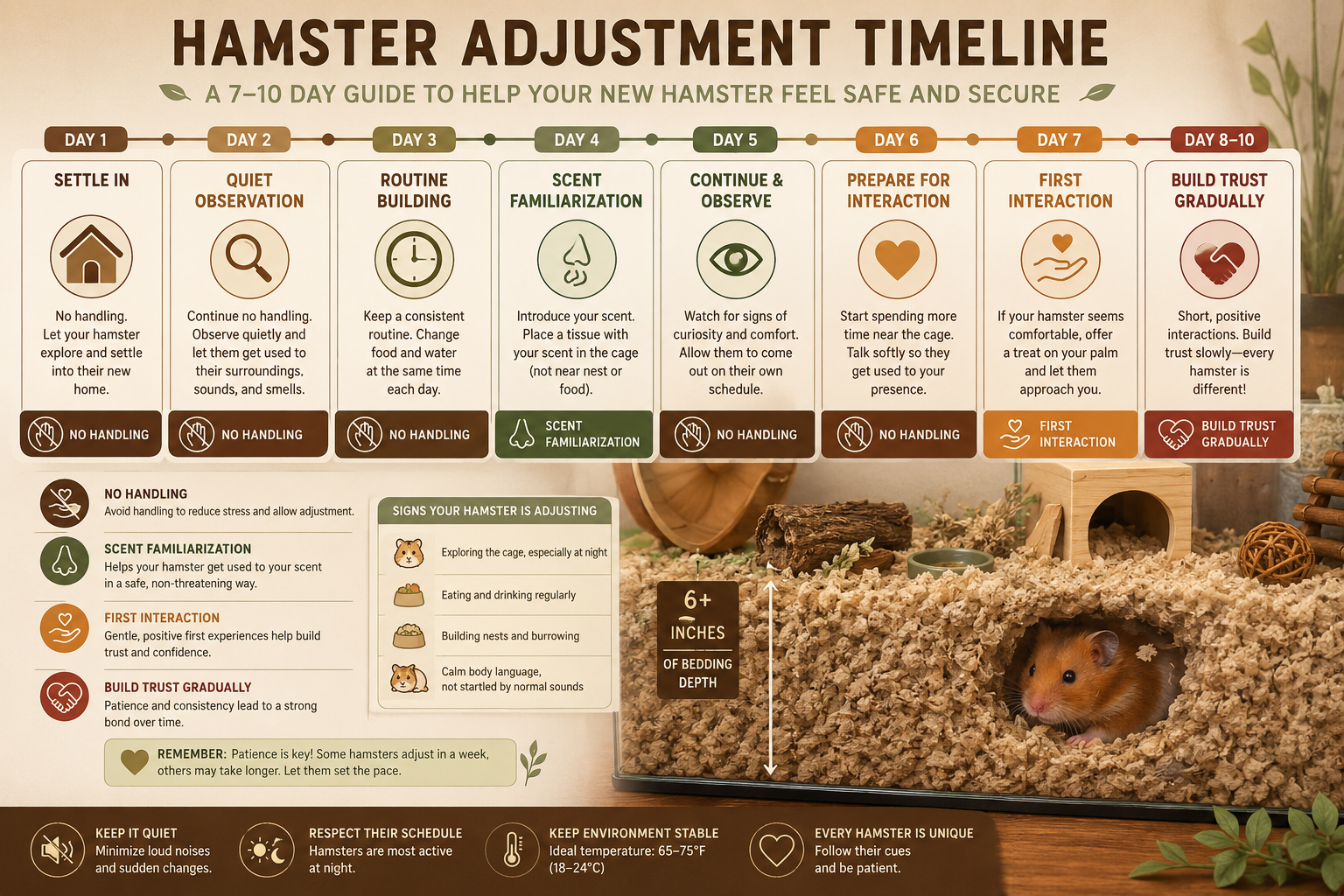
- Leave your hamster completely alone for 3-5 days minimum,no handling, no cage rearranging, only essential food and water checks
- Syrian hamsters typically need 5-7 days while dwarf species may adjust in 3-5 days, but individual temperament matters more than species
- Signs of readiness include active scent marking, confident exploration, and approaching the cage front when you’re nearby
- Premature handling causes chronic stress that manifests as aggression, bar chewing, and increased disease susceptibility
- The adjustment period starts over if you move the cage or change the setup during the first two weeks
Understanding the New Hamster Adjustment Period
The new hamster adjustment period is the time your hamster needs to acclimate to their environment before any handling begins. This isn’t about convenience, it’s about survival instinct.
In the wild, hamsters are prey animals. Every new environment represents potential danger until proven otherwise. Your hamster arrives home after a stressful journey involving transport, unfamiliar smells, and complete loss of territorial control. Their stress hormone levels are already elevated.
What Happens During Adjustment
During the first 3-7 days, your hamster is conducting a security assessment. They’re:
- Mapping escape routes by exploring every corner of the cage
- Establishing a nest site where they feel most protected
- Scent marking territory through cheek rubbing and urine deposits
- Testing food and water sources to confirm reliable access
- Monitoring threat patterns by learning your household’s noise schedule
This process can’t be rushed. A hamster who hasn’t completed this assessment remains in a state of hypervigilance. Their cortisol levels stay elevated, suppressing immune function and digestive efficiency.
Species Differences in Adjustment Time
Syrian hamsters generally need 5-7 days minimum. They’re solitary and highly territorial, requiring more time to accept a new space as “theirs.” Syrians who don’t get adequate adjustment time often develop aggressive responses to handling that persist for months.
Dwarf hamsters (Winter White, Campbell’s, Roborovski) may adjust in 3-5 days. They’re naturally more skittish but less territorial than Syrians. However, Roborovski hamsters are exceptionally fast and nervous, they often need the full 7 days despite being dwarf species.
Chinese hamsters fall somewhere in between, typically needing 4-6 days. Their semi-social nature means they’re slightly more adaptable to environmental changes than Syrians.
These are minimums. A hamster from a chaotic pet store environment may need 10-14 days. A hamster who experienced rough handling before you got them needs longer. Signs of stress in hamsters include excessive hiding, bar chewing, and aggressive lunging, if you see these, extend the adjustment period.
The First 24-48 Hours: Critical Setup Period
The first two days are about cage setup and environmental stability. Get this wrong, and you’ll extend the adjustment period significantly.
Cage Setup Before Arrival
Your cage should be completely ready before your hamster arrives. This means:
- Minimum 450 square inches of floor space (600+ for Syrians)
- 6-8 inches of bedding depth for burrowing behaviour, this is non-negotiable for stress reduction
- Wheel size appropriate to species: 8-inch minimum for dwarf hamsters, 10-12 inches for Syrians
- Multiple hideouts with at least one that’s fully enclosed and opaque
- Bar spacing no wider than 0.4 inches for dwarf species, 0.5 inches for Syrians
- Water bottle tested for leaks and positioned at comfortable height
- Food bowl in open area away from nest site
Place enrichment items (chew toys, tunnels, platforms) before your hamster arrives. Moving things around during adjustment resets their mental map and extends the stress period.
Transfer and Initial Placement
When you bring your hamster home, minimize the transfer stress:
- Place the transport container directly in the cage and open it
- Let your hamster exit on their own timeline,this can take 5-60 minutes
- Remove the transport container only after they’ve left it
- Leave the room immediately
Do not watch them explore. Your presence is a predator signal. They won’t exhibit natural behaviour while you’re visible.
What to Avoid in the First 48 Hours
- No handling whatsoever,not even “just to check if they’re okay”
- No cage rearranging,resist the urge to “improve” the setup
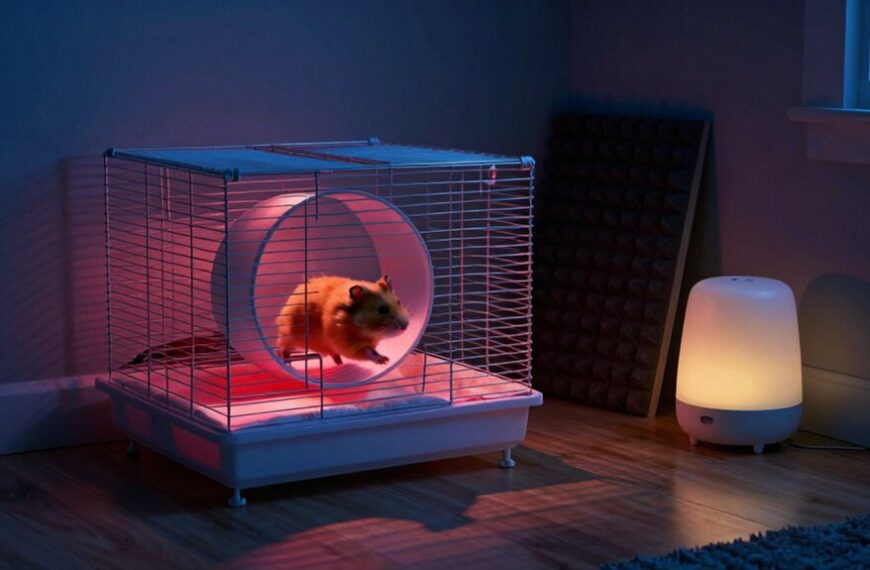
- No flash photography or bright lights aimed at the cage
- No introducing them to other pets or family members
- No loud noises near the cage (vacuum cleaners, music, shouting)
Check food and water levels once daily, ideally at the same time each day. Make this check quick and quiet. If you need to refill water, do it when your hamster is in their hideout, not when they’re exploring.
Days 3-7: The Core New Hamster Adjustment Period
This is when most of the psychological adjustment happens. Your hamster should be showing increasingly confident behaviour if the environment is appropriate.
Normal Adjustment Behaviours
Days 3-4: Your hamster should be emerging from their hideout regularly during their active period (evening/night). You’ll notice:
- Scent marking along cage perimeter,they’ll rub their cheeks on corners and objects
- Bedding rearrangement,they’re customizing their space
- Food hoarding,stashing food in their nest is normal and healthy
- Wheel usage,a hamster who runs on their wheel is starting to feel secure
Days 5-7: Confident hamsters will:
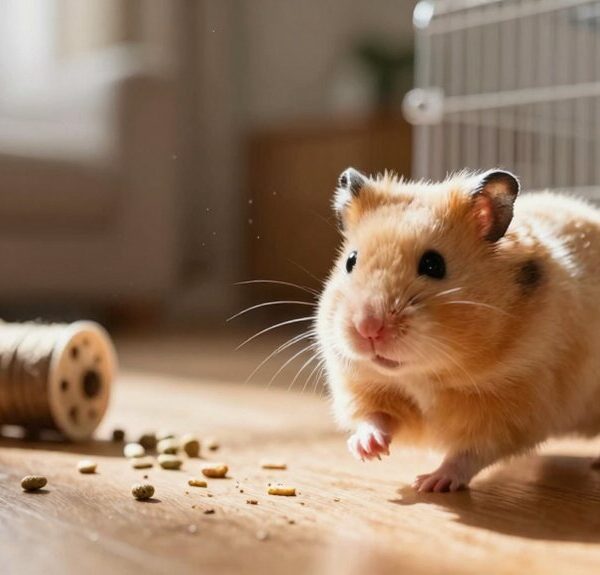
- Approach the cage front when they smell you nearby
- Groom themselves in open areas,grooming in the open signals reduced fear
- Explore during early evening even if household activity is moderate
- Respond to your voice by pausing and orienting toward the sound rather than fleeing
Red Flags That Require Extended Adjustment
Some behaviours indicate your hamster needs more time:
- Remaining hidden 24/7 beyond day 4
- Aggressive cage bar biting that creates noise and visible stress
- Refusing to eat or significant weight loss
- Wet tail symptoms: diarrhea, lethargy, hunched posture (requires immediate vet care)
- Repetitive pacing or stereotypic behaviour patterns
If you see these signs, extend the no-contact period to 10-14 days. Review your cage setup, inadequate space, wrong wheel size, or insufficient bedding depth are common causes. What not to do with a hamster covers setup mistakes that prolong stress.
Environmental Factors That Affect Adjustment
Cage location matters. Hamsters adjust faster when their cage is:
- Away from direct sunlight and heat sources
- In a room with consistent temperature (65-75°F)
- Away from high-traffic areas but not completely isolated
- Protected from other pets who might stare at or paw the cage
Household noise patterns affect adjustment speed. Hamsters adapt to predictable noise (regular TV volume, normal conversation) but struggle with unpredictable loud sounds (door slamming, dog barking, children screaming).
If your household is chaotic, place the cage in the quietest available room and expect to add 3-5 days to the adjustment period.
When and How to Begin Interaction
The transition from observation to interaction requires careful timing and technique. Move too fast, and you’ll trigger defensive behaviour that’s hard to reverse.
Readiness Indicators
Your hamster is ready for initial interaction when they consistently show all of these behaviours:
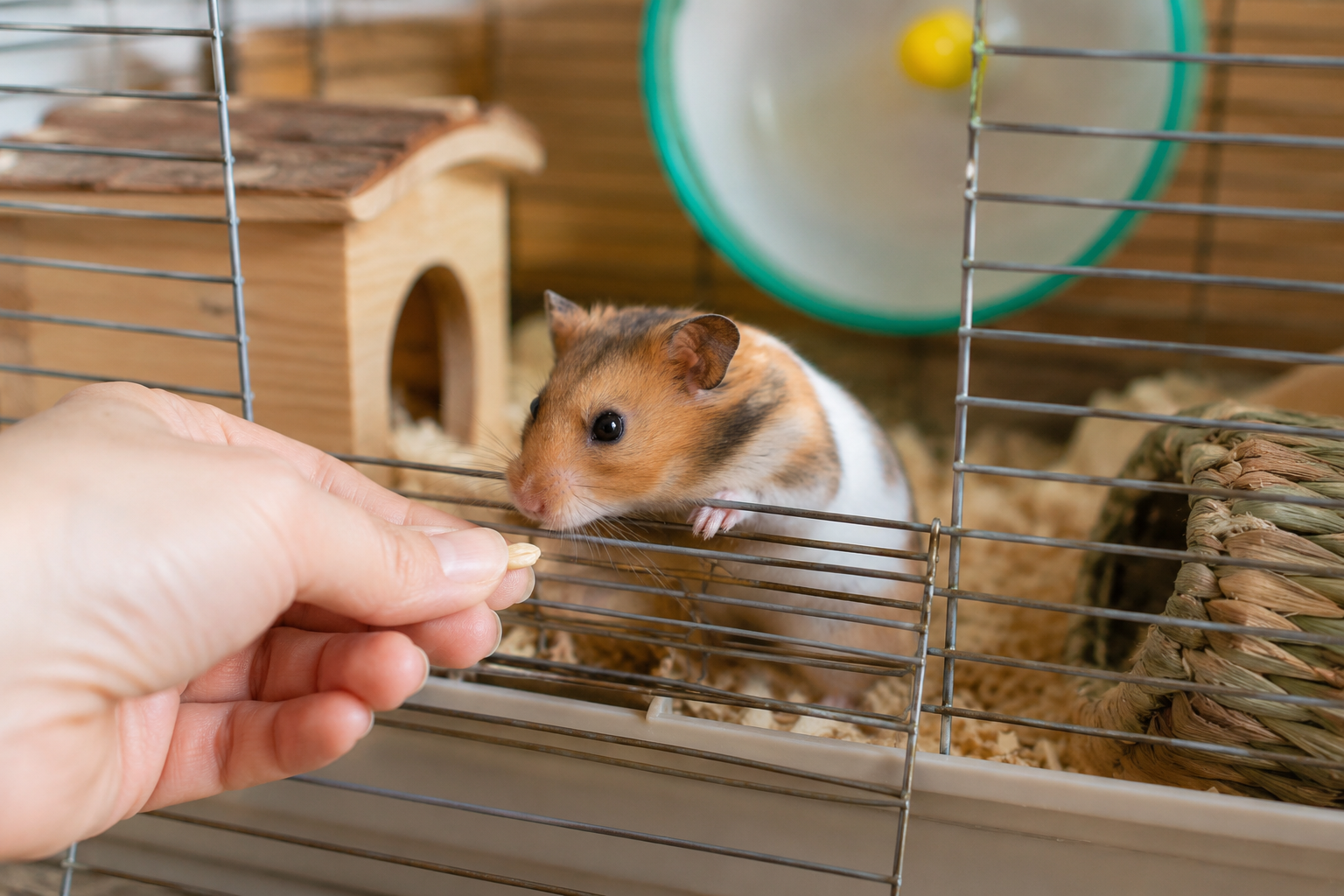
✅ Approaches the cage front when you’re nearby, showing curiosity rather than fear
✅ Takes treats through the bars without immediately fleeing
✅ Continues normal activity (grooming, eating, exploring) when you’re in the room
✅ Responds to your voice by orienting toward you rather than hiding
✅ Has established clear routines,predictable wake times and activity patterns
If your hamster shows only some of these signs, wait another 2-3 days. Partial readiness isn’t readiness.
The Scent Introduction Phase (Days 7-10)
Before any handling, do scent introduction:
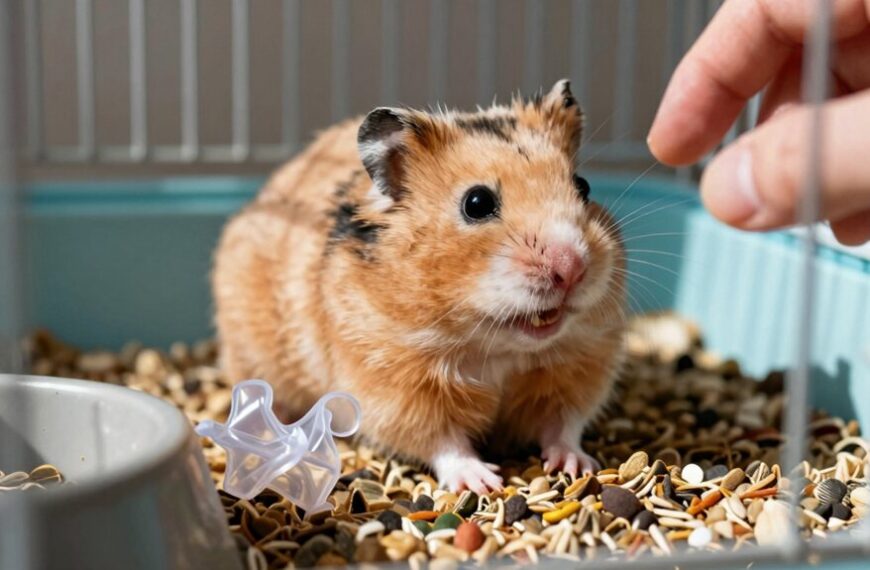
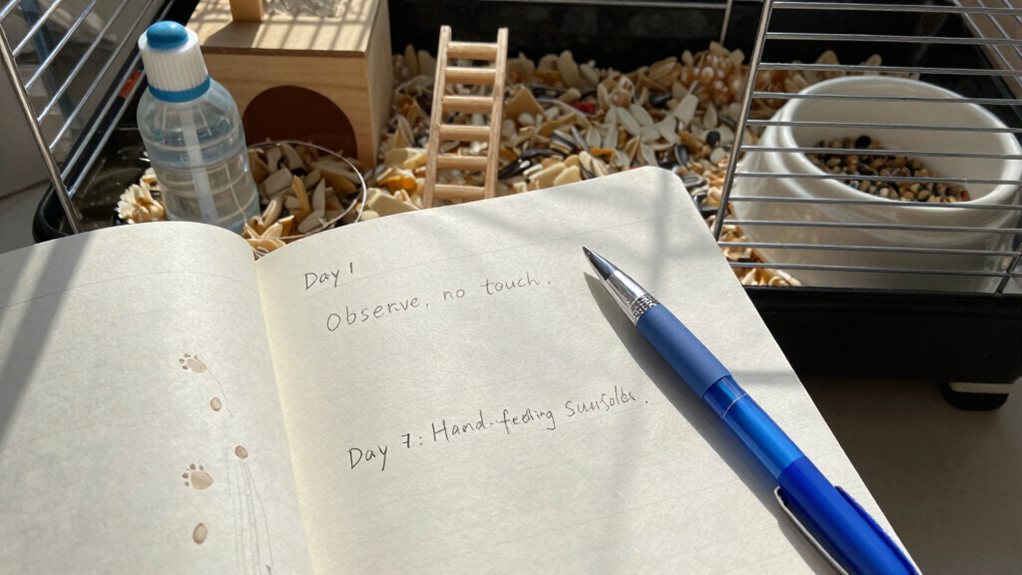
Day 7-8: Place your hand flat on the outside of the cage for 5-10 minutes during your hamster’s active time. Let them approach and sniff through the bars. Don’t move your hand, let them control the interaction.
Day 8-9: Place a small treat (sunflower seed, tiny piece of carrot) near the cage bars. Let your hamster take it while you remain still. Repeat this 2-3 times over two days.
Day 9-10: Offer a treat from your fingertips through the bars. If your hamster takes it confidently, you’re ready for the next phase. If they snatch and run, continue this step for another 2-3 days.
First Handling Session
When your hamster consistently takes treats from your fingers, attempt first handling:
- Open the cage during their active period,never wake a sleeping hamster
- Place your hand flat in the cage with a treat on your palm
- Wait for them to climb on,do not grab or chase
- Lift slowly only if they’re fully on your hand with all four feet
- Keep the first session under 2 minutes and stay near the cage
- Return them to the cage at first sign of stress (freezing, attempting to jump, squeaking)
If your hamster won’t climb onto your hand after 5 minutes, remove your hand and try again the next day. Forcing interaction destroys trust.
For detailed bonding techniques specific to different species, see our guide on how to bond with your Winter White hamster, the principles apply to all species with minor timing adjustments.
Common First-Interaction Mistakes
Approaching from above: Hamsters perceive overhead movement as predator attack. Always approach from their eye level or below.
Grabbing instead of scooping: Grabbing triggers panic. Use both hands to create a scoop, letting your hamster walk into your cupped palms.
Handling during sleep hours: A hamster woken from sleep is disoriented and more likely to bite. Winter White hamster bites can break skin, avoid creating situations that trigger defensive biting.
Extended first sessions: Keep initial handling under 5 minutes. Longer sessions cause stress that undoes adjustment progress.
Inconsistent timing: Handle your hamster at the same time each day during their active period. Unpredictable interaction schedules maintain stress.
Special Circumstances That Extend Adjustment
Some situations require modified timelines and approaches.
Rehomed or Rescued Hamsters
Hamsters from previous homes need 7-14 days minimum, sometimes longer. They’re processing both environmental change and potential trauma from previous handling or living conditions.
Signs a rehomed hamster needs extended adjustment:
- Extreme skittishness beyond normal species behaviour
- Aggressive responses to any hand movement near the cage
- Self-harm behaviours (excessive grooming, bar chewing that causes injury)
- Complete refusal to eat for 48+ hours
For these hamsters, extend the no-contact period to 14 days and consider consulting an exotic vet about stress-reduction supplements.
Post-Illness or Vet Visit Adjustment
If your hamster requires vet care during the initial adjustment period, the timeline resets. Medical handling is traumatic, your hamster needs another 3-5 days of minimal interaction after returning home.
The same applies if you need to deep-clean the cage due to illness. Removing all scent markers forces your hamster to re-establish territory, which extends adjustment by 3-7 days.
Multiple Hamster Households
If you’re adding a second hamster to your household (in a separate cage, hamsters require solitary housing), the new hamster needs the full adjustment period while your established hamster may show stress from the new scent.
Keep cages in separate rooms during the new hamster’s adjustment period. The scent of an unfamiliar hamster can trigger territorial stress in your established hamster, leading to increased aggression or anxiety.
Young Children in the Household
Hamsters in homes with children under 8 need extended adjustment periods, typically 7-10 days minimum. Children struggle with the “no touching” rule, and their higher-pitched voices and unpredictable movements are more stressful to hamsters.
Establish clear rules before bringing your hamster home:
- No tapping on the cage or trying to wake the hamster
- No loud noises near the cage
- No unsupervised interaction until the hamster is fully adjusted and the child demonstrates proper handling technique
Consider placing the cage in an adult bedroom during adjustment if children can’t consistently follow these rules.
Long-Term Benefits of Proper Adjustment
Hamsters who receive adequate adjustment time show measurably better outcomes:
Health benefits: Lower stress hormone levels mean stronger immune function. Properly adjusted hamsters have lower rates of wet tail, respiratory infections, and stress-induced digestive issues. The leading cause of death in hamsters is often stress-related illness that could have been prevented with proper adjustment.
Behavioural benefits: Hamsters who adjust properly are:
- Less likely to develop aggressive handling responses
- More consistent in their activity patterns
- Less prone to stereotypic behaviours (bar chewing, repetitive pacing)
- Easier to handle for necessary care (nail trims, health checks)
Bonding benefits: A hamster who trusts their environment from the start forms positive associations with your presence faster. You’ll spend less total time on trust-building compared to trying to reverse stress-induced fear responses.
Lifespan considerations: Chronic stress shortens hamster lifespan. Syrian hamsters typically live 2-3 years, dwarf species 1.5-2.5 years. Hamsters who experience prolonged adjustment stress often die 6-12 months earlier than properly adjusted hamsters due to stress-related organ damage.
Monitoring Progress and Adjusting Your Approach
Track your hamster’s adjustment using specific behavioural markers:
Week 1 checklist:
- Eating and drinking regularly
- Using the wheel
- Emerging from hideout during active hours
- Scent marking visible (check for cheek rubbing on corners)
- Normal droppings (firm, dark, consistent size)
Week 2 checklist:
- Approaches cage front when you’re nearby
- Takes treats from your hand through bars
- Continues activity when you enter the room
- Shows curiosity about your presence rather than fear
- Maintains healthy weight (visible but not prominent spine)
If your hamster isn’t meeting these markers, review environmental factors:
Cage size: Hamsters in cages under 450 square inches show prolonged stress regardless of adjustment time. Upgrade to appropriate size before expecting normal adjustment.
Wheel size: Wrong wheel size prevents natural running behaviour, maintaining stress. Syrians on wheels under 10 inches develop back problems and show increased anxiety.
Bedding depth: Less than 6 inches prevents burrowing behaviour, which is essential for stress regulation. Increase bedding depth and expect 3-5 days for your hamster to adjust to the change.
Bar spacing: Dwarf hamsters in cages with bar spacing over 0.4 inches may escape or get stuck attempting escape, creating ongoing stress. Switch to appropriate housing.
For comprehensive setup guidance, review what are must-haves for hamsters to ensure you’re not missing critical elements.
FAQ
Can I clean the cage during the adjustment period?
No. Spot-clean only if absolutely necessary (removing soiled bedding from a specific area), but avoid full cage cleaning for the first 2-3 weeks. Removing scent markers resets the adjustment process. If you must spot-clean, remove only the soiled section and leave at least 80% of the bedding undisturbed.
What if my hamster isn’t eating after 48 hours?
Check that you’re offering the same food they ate at the pet store, sudden diet changes cause refusal to eat. Place food in multiple locations, including near their hideout. If they’re still not eating after 72 hours, consult an exotic vet immediately. Weight loss happens rapidly in hamsters and can be fatal.
Is it okay to talk to my hamster during adjustment?
Yes, but keep your voice low and calm. Speaking softly helps your hamster learn your voice as a non-threatening sound. Avoid sudden loud noises or high-pitched talking. Consistency matters, if you talk to them daily, they’ll adjust to your voice faster.
My hamster is bar chewing constantly. Should I handle them to calm them down?
No. Bar chewing during adjustment indicates the cage is too small, lacks enrichment, or the hamster needs more time. Handling will increase stress. Review your cage setup first, bar chewing usually signals inadequate space or boredom, not a need for interaction. Add more enrichment and ensure minimum size requirements are met.
Can I move the cage to a different room during adjustment?
Avoid this if possible. Moving the cage forces your hamster to restart their security assessment in a new location, extending adjustment by 3-5 days. If you must move the cage, do it once and then commit to that location for at least 3 weeks.
How do I know if my hamster is just naturally shy versus still adjusting?
Natural shyness persists even after adjustment but doesn’t prevent normal behaviour. A shy but adjusted hamster will still eat, drink, use their wheel, and explore when they think you’re not watching. A hamster still adjusting shows stress behaviours: remaining hidden 24/7, refusing to eat, aggressive responses to any stimuli, or stress-induced diarrhea. What relaxes a hamster can help you create an environment that accommodates naturally shy personalities.
Conclusion
The new hamster adjustment period is the foundation of your relationship with your hamster. Three to seven days of hands-off observation isn’t wasted time, it’s an investment that pays dividends in your hamster’s health, behaviour, and lifespan.
Your action plan:
- Set up the cage completely before bringing your hamster home, minimum 450 square inches, 6-8 inches of bedding, appropriate wheel size, multiple hideouts
- Leave your hamster alone for 5-7 days (3-5 for dwarf species, 5-7 for Syrians), check food and water once daily, no handling
- Watch for readiness signs: approaching the cage front, taking treats confidently, continuing activity when you’re present
- Begin scent introduction on day 7-8 with hand placement outside the cage, progressing to treat-taking through bars
- Attempt first handling only when your hamster climbs onto your hand voluntarily, never grab or chase
If your hamster shows stress behaviours beyond day 7, extend the adjustment period and review your cage setup. Most adjustment problems stem from inadequate housing, not hamster temperament.
The patience you show during these first days determines whether you’ll have a confident, handleable hamster or spend months trying to reverse stress-induced fear responses. Give your hamster the time they need, and they’ll reward you with years of easier care and genuine trust.